The strongest version of yourself. Your body is your pension!!!!
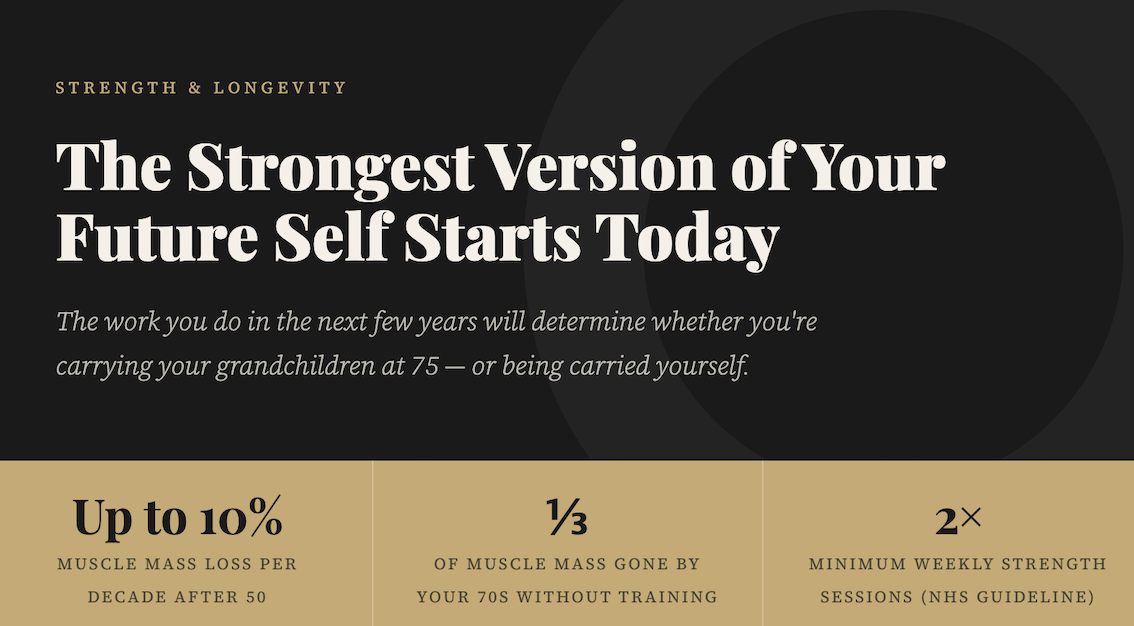
Most people don't think about what 75 looks like until they're already there. That's the problem. There's a quiet assumption most of us carry through our forties and fifties — that slowing down is just what happens. That stiffness, weakness, and fragility are the natural tax of getting older.
They're not. And the research on this is no longer ambiguous. Strength training — progressive, consistent, challenging — is one of the most powerful things you can do to protect your body, your independence, and your life expectancy.
Why muscle mass is a life-or-death issue
From around our mid-thirties, we begin losing muscle mass at roughly 3–5% per decade. By our seventies, someone who has done nothing to counteract this can have lost a third or more of the muscle they had in their prime. Clinically, this is called sarcopenia — and it's one of the leading contributors to falls, fractures, hospitalisation, and premature death.
A major study published in the British Medical Journal found that muscle weakness in midlife is strongly associated with higher all-cause mortality, independent of cardiovascular fitness. Grip strength alone has been shown to predict future disability more accurately than blood pressure in some populations. Your muscles are not just for lifting things — they regulate blood sugar, support bone density, protect your joints, and keep your heart working efficiently.
The NHS physical activity guidelines recommend muscle-strengthening activity at least twice a week for adults. Most people do not meet this threshold.
"Stretching will not help you lift a bag of compost. It will not stabilise your knee as you step off a ladder. Functional strength comes from trained muscle."
Stretching is not enough — and here's why
Flexibility is lovely. A good stretch feels wonderful. But it will not catch you when you stumble, let you carry your grandchildren, or get you up off the floor without looking for something to hold onto. Functional strength comes from regularly asking your body to work against resistance — and then asking it to work a little harder over time.
That second part is everything. The body adapts quickly. If you do the same exercise at the same weight indefinitely, you stop making progress. Progressive overload — gradually increasing demand on your muscles through heavier weights, more repetitions, or more challenging movements — is what drives real, lasting change. It's what separates maintenance from genuine improvement.
Progressive overload in practice
10 reps bodyweight→12 reps→Add light weight→Increase load→More complex movement
What this actually looks like — it's not what you think
Strength training does not mean competing with people half your age. It exists on a spectrum, and wherever you start is the right place. Begin at home — no equipment, no audience, no pressure.
1 Chair squats
Stand up, sit back down. Add a weighted rucksack as you progress. This is the movement that keeps stairs easy for decades.
2 Wall press-ups
Hands on the wall, step back, press. Builds shoulder strength for overhead reach, carrying shopping, and pushing up from low seats.
3 Step-ups
One leg at a time on the bottom stair, slow tempo. Builds the balance and hip strength that prevents the falls that change lives.
4 Resistance bands
Inexpensive and effective. A simple row movement builds the back strength that protects your posture and spine for decades.
5 Bodyweight hinges
Hinge forward with a slight knee bend, keep the back long, return to standing. Protects your lower back every single time you bend down.
Once those feel comfortable, take it further. Many leisure centres offer over-50s sessions specifically designed for supported strength work. Classes like Body Pump, kettlebell circuits, or resistance pilates all count. Personal trainers who specialise in older adults are more accessible and more affordable than most people assume.
Some people train alone. Others need a class, a gym buddy, or a structured programme to stay consistent. Consistency is the variable that matters most — and the best programme is the one you actually do, and keep making harder over time.
This does not need to be frightening. BUT science very strongly suggests in NEEDS to be done.
The investment logic is overwhelming
Every decade you delay costs more to recover. The muscle you build at 50 protects you at 70. The strength you develop now reduces your fracture risk, lowers your likelihood of needing hip or knee surgery, and significantly improves your chances of living independently well into old age.
This is not about aesthetics. It is about being able to do things — to carry, to climb, to squat down and play with a child, to travel without your body becoming the limiting factor. The research is consistent and emphatic: people who engage in regular strength training live longer, live better, and suffer fewer serious injuries. The investment is modest. The return is enormous.
If you need or would like help with any of the above, book in to see one of our osteopaths who can advise. OR call us on 020 8605 2323