London Marathon 2026: A Complete Guide to Bone Stress Injuries in Runners

With the London Marathon 2026 training cycle now building momentum, this is the period when we commonly see bone stress injuries emerging in runners across Earlsfield, Wandsworth and SW18.
Understanding the early signs can be the difference between finishing the race — or missing the season entirely.
What Is a Bone Stress Injury?
Bone stress injuries (BSIs) occur when repeated impact loading exceeds the bone’s ability to remodel and recover. They sit on a spectrum:
Stress reaction (early overload)
Stress fracture (structural crack)
During marathon training, runners may take 30,000–50,000 steps per long run. If recovery, nutrition and strength capacity don’t match the load, bone tissue begins to fail.
Common Locations in Marathon Runners
Tibia (shin) – the most common site
Metatarsals (forefoot) – pain during push-off
Calcaneus (heel) – deep heel ache
Femoral neck – deep groin pain (higher-risk and needs urgent assessment)
Early Warning Signs
Bone stress injuries rarely start dramatically. They build gradually.
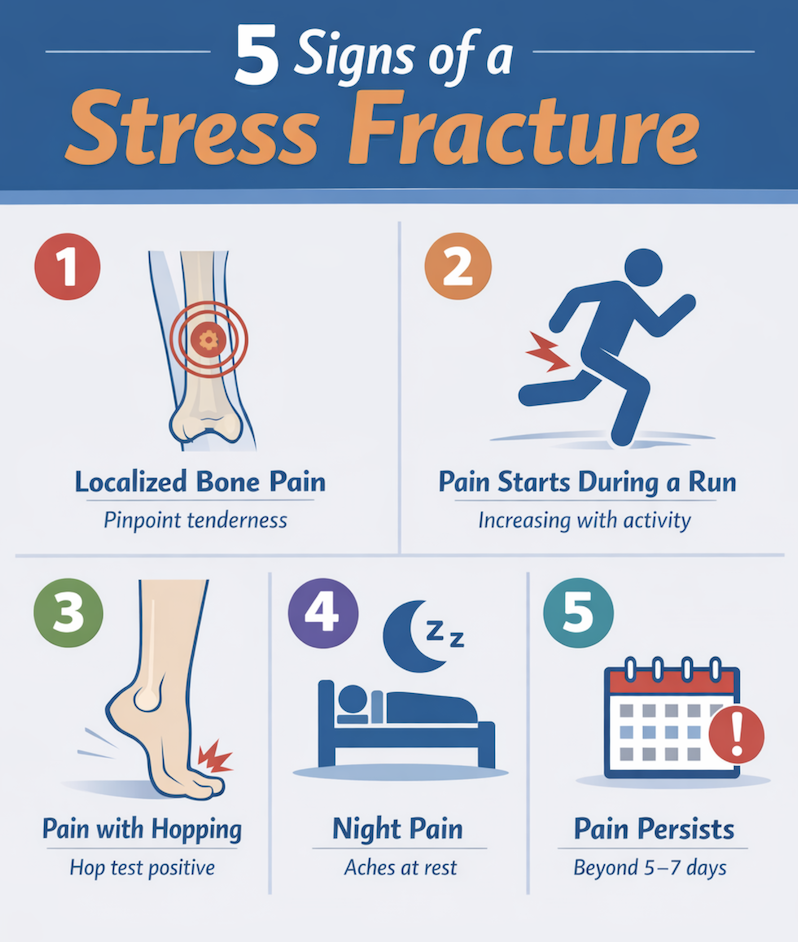
Watch for:
Localised pain (you can pinpoint it precisely)
Pain that appears earlier in each run
Pain on single-leg hopping
Pain that persists after the run
Pain that begins to hurt during walking
Night pain (more concerning)
If pain is broad and diffuse, it may be shin splints. If it is sharp and focal, think bone.
Why They Increase During Marathon Training
Several risk factors stack up during London Marathon preparation:
1. Rapid Mileage Progression
Jumping from 15km to 25km long runs within weeks.
2. Hard Winter Surfaces
More pavement running, less terrain variation.
3. Inadequate Recovery
Busy professional schedules often compromise sleep and fuelling.
4. Low Energy Availability
Under-fuelling reduces bone turnover and resilience. This is particularly relevant in endurance athletes and female runners, but affects men too.
5. Lack of Strength Training
Bone responds to heavy load and varied force. Many marathon runners accumulate mileage but neglect progressive strength work.
Prevention: What Actually Works
Evidence supports:
Gradual mileage increases (avoid >10% weekly spikes)
Heavy calf raises (straight and bent knee)
Split squats and single-leg strength
Progressive plyometrics
Adequate carbohydrate intake around training
Sleep >7 hours per night
Bone health is influenced by both load and energy availability.
When to Stop Running
You should stop and seek assessment if:
Pain is focal and worsening
Walking becomes painful
Hopping is painful
Pain is deep in the groin
Continuing to train through a stress reaction often progresses it into a full stress fracture.
How We Help at Back to Back Osteopaths (SW18)
For runners in Earlsfield and Wandsworth training for London 2026, we assess:
Load management and weekly mileage
Strength capacity vs training demand
Running mechanics
Recovery strategies
Nutrition risk factors
Early intervention often means modifying training rather than stopping completely.
If you are preparing for London 2026 and experiencing persistent, localised pain — don’t ignore it.
A small problem in February can become a season-ending injury by April.
By James Dodd BSc (hons) Ost. FAFS.
GOsC registered